
Predictive credit management is rapidly transforming how businesses approach financial risk and debt recovery. In today’s dynamic financial landscape, organizations must anticipate financial obligations rather than react to them. As a result, traditional credit management and debt collection models are being replaced by data-driven, agile strategies.
So, how does predictive credit management reshape financial operations? Simply put, it combines advanced analytics, intelligent automation, and proactive decision-making to improve outcomes. Consequently, businesses can reduce risk, enhance cash flow, and strengthen customer relationships.
What Is Predictive Credit Management?
Foreseeing Financial Risk with Data
Predictive credit management uses machine learning and advanced analytics to forecast customer payment behavior. Unlike traditional models, it evaluates diverse datasets such as:
- Transaction histories
- Payment patterns
- Macroeconomic indicators
- Industry trends
As a result, businesses can identify potential defaults early. Moreover, they can adjust credit terms proactively instead of reacting to late payments.
Why Predictive Credit Management Matters
For example, small and medium enterprises can now compete with larger firms by leveraging predictive tools. In addition:
- They can reduce bad debt exposure
- They improve credit decision accuracy
- They optimize working capital
Agile Debt Resolution: A Modern Approach
Moving Beyond Traditional Collections
While predictive credit management prevents risk, agile debt resolution ensures efficient recovery. Traditionally, debt collection was reactive and manual. However, modern approaches prioritize:
- Speed
- Flexibility
- Data-driven decision-making
Therefore, organizations can recover debts more effectively while maintaining customer relationships.
Intelligent Automation in Debt Collection
Enhancing Efficiency through Technology
Automation plays a critical role in predictive credit management ecosystems. For instance:
- Automated reminders reduce manual workload
- AI chatbots handle routine queries
- Workflow automation accelerates collections
As a result, teams can focus on complex, high-value cases.
Personalization and Early Intervention
A Data-Driven Collection Strategy
Another key advantage of predictive credit management is personalization. By analyzing debtor behavior:
- Businesses tailor communication strategies
- Customers receive flexible repayment options
- Engagement improves significantly
Furthermore, early-stage intervention prevents escalation. Instead of waiting for delinquency, companies act immediately when risk signals appear.
The Role of Data Analytics
Continuous Optimization
Data analytics strengthens predictive credit management by enabling continuous improvement. Specifically, organizations can:
- Evaluate credit policies
- Measure collection effectiveness
- Refine strategies in real time
Consequently, decision-making becomes more precise and adaptive.
FinTech Integration and Financial Ecosystems
Connecting Credit and Collections
Modern FinTech platforms integrate:
- Credit scoring systems
- Automated invoicing
- Payment processing
Therefore, businesses gain a unified financial view. This integration enhances predictive credit management by linking credit decisions directly to recovery processes.
Compliance and Ethical Debt Recovery
Building Trust through Transparency
Equally important, predictive systems ensure compliance with regulatory standards. In addition:
- Automated workflows reduce legal risks
- Transparent processes build customer trust
- Ethical practices protect brand reputation
Thus, predictive credit management supports both profitability and compliance.
The Future of Predictive Credit Management
AI and Machine Learning Advancements
Looking ahead, predictive credit management will become even more sophisticated. For example:
- AI will enhance credit scoring accuracy
- Predictive models will anticipate customer churn
- Automated negotiations will improve recovery rates
As a result, businesses will operate with greater financial intelligence.
Strategic Benefits for Businesses
By adopting predictive credit management, organizations can:
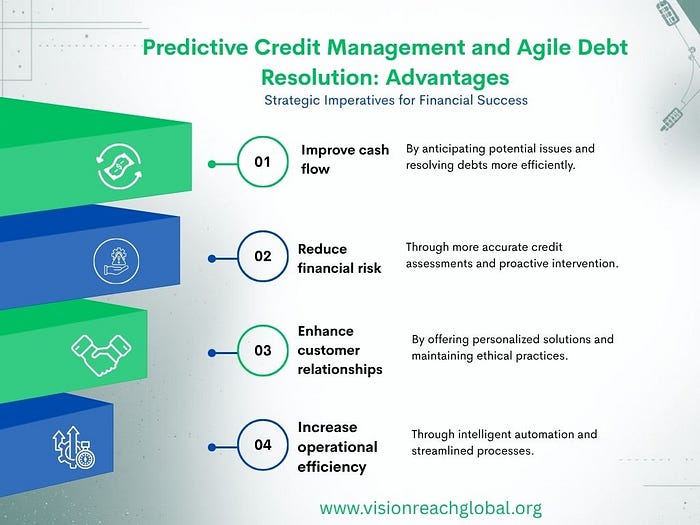
- Improve cash flow: By anticipating potential issues and resolving debts more efficiently.
- Reduce financial risk: Through more accurate credit assessments and proactive intervention.
- Enhance customer relationships: By offering personalized solutions and maintaining ethical practices.
- Increase operational efficiency: Through intelligent automation and streamlined processes.
Conclusion
In conclusion, predictive credit management is a strategic necessity. As financial environments become more complex, businesses must shift from reactive to proactive models.
Therefore, organizations that embrace predictive analytics, automation, and agile debt resolution will outperform competitors. Ultimately, the future of finance belongs to those who anticipate risk, act early, and adapt quickly.