
In today’s hyper-competitive landscape, organizations are drowning in data. Yet, this deluge presents an unprecedented opportunity. The ability to effectively harness big data analytics is a fundamental driver of competitive advantage. Enterprises are rapidly shifting from gut-feel decisions to data-informed strategies, demanding real-time data processing and intelligent decision-making capabilities. Notably, this transformation is powered by a new generation of scalable technologies like Apache Spark, Hadoop, Python, and Apache NiFi. Therefore, this piece will explore how these tools are revolutionizing operations and enabling businesses to unlock actionable insights from their vast data reserves.
The New Era of Big Data Analytics
The landscape of data management has evolved dramatically. Gone are the days of solely dealing with neatly structured databases. Today’s big data ecosystems must effectively process structured, semi-structured, and unstructured data, from customer transaction logs to social media feeds and sensor readings. As a result, such complexities necessitate distributed computing, a paradigm that breaks down massive datasets across multiple machines for parallel processing.
The true power lies in real-time analytics, allowing businesses to react instantaneously to changing market conditions, and predictive intelligence, enabling them to anticipate future trends and customer behaviors.
Big Data Analytics with Apache Spark
At the forefront of high-speed data processing stands Apache Spark. Its architecture and components are designed for speed, leveraging in-memory data processing to achieve analytics speeds orders of magnitude faster than traditional disk-based systems. Spark’s versatility shines through its modules: Spark SQL for structured data querying, Spark Streaming for near real-time data ingestion and processing, MLlib for powerful machine learning capabilities, and GraphX for graph analytics.
These functionalities unlock powerful use cases, from real-time analytics on streaming data to sophisticated machine learning models for prediction and anomaly detection. That said, optimizing Spark performance and ensuring scalability are crucial for enterprises to handle growing data volumes.
Big Data Analytics Using Python
Python has cemented its position as a leading language for data analytics and Artificial Intelligence. Its extensive libraries offer a robust toolkit for every stage of the analytical process. As such, Pandas, NumPy, and SciPy provide powerful data manipulation, numerical computation, and scientific computing capabilities. Thus, for insightful understanding, Matplotlib and Seaborn deliver compelling data visualization options.
When it comes to building intelligent systems, Scikit-learn offers a comprehensive suite for machine learning and predictive analytics, while TensorFlow (and its counterpart PyTorch) enables deep learning model development. In a nutshell, Python’s ease of use also facilitates the automation of data workflows and analytical pipelines, streamlining operations.
Big Data Analytics Using Hadoop
The Hadoop ecosystem remains a cornerstone for managing and processing enormous datasets. Its core components include the Hadoop Distributed File System (HDFS), which is a resilient and scalable storage solution for massive datasets, and MapReduce, the foundational framework for distributed data processing. YARN acts as the cluster’s resource manager, orchestrating job scheduling and resource allocation.
On the other hand, for data warehousing and querying, tools like Hive and Pig provide higher-level abstractions over MapReduce. Ultimately, Hadoop’s inherent scalability, fault tolerance, and mature enterprise deployment considerations make it a robust choice for large-scale data initiatives.
Data Flow Automation with Apache NiFi
Efficiently moving and transforming data is critical. Apache NiFi excels in this domain, employing a flow-based programming model that visually orchestrates complex data pipelines. It simplifies data ingestion, routing, transformation, and integration from diverse sources.
NiFi’s capabilities extend to real-time streaming data management and proactive monitoring, ensuring data flows smoothly and predictably. Its built-in secure data movement and governance capabilities are paramount for maintaining data integrity and compliance. Furthermore, NiFi seamlessly integrates with other big data technologies like Spark, Hadoop, and various cloud platforms, creating a unified data flow.
Integrating Big Data Technologies for Enterprise Intelligence
The true power of big data analytics is unleashed when these technologies are integrated to build end-to-end big data pipelines. Combining the processing speed of Spark, the storage and batch processing capabilities of Hadoop, the analytical prowess of Python, and the data flow automation of NiFi creates a formidable analytics engine.
Evidently, modern enterprises are increasingly adopting cloud-based big data architectures and hybrid deployments to leverage scalability and flexibility. Crucially, robust data governance, security, and compliance considerations must be embedded throughout these architectures to ensure responsible and ethical data handling, ultimately operationalizing analytics for business intelligence and decision support.
Real-World Applications of Big Data Analytics
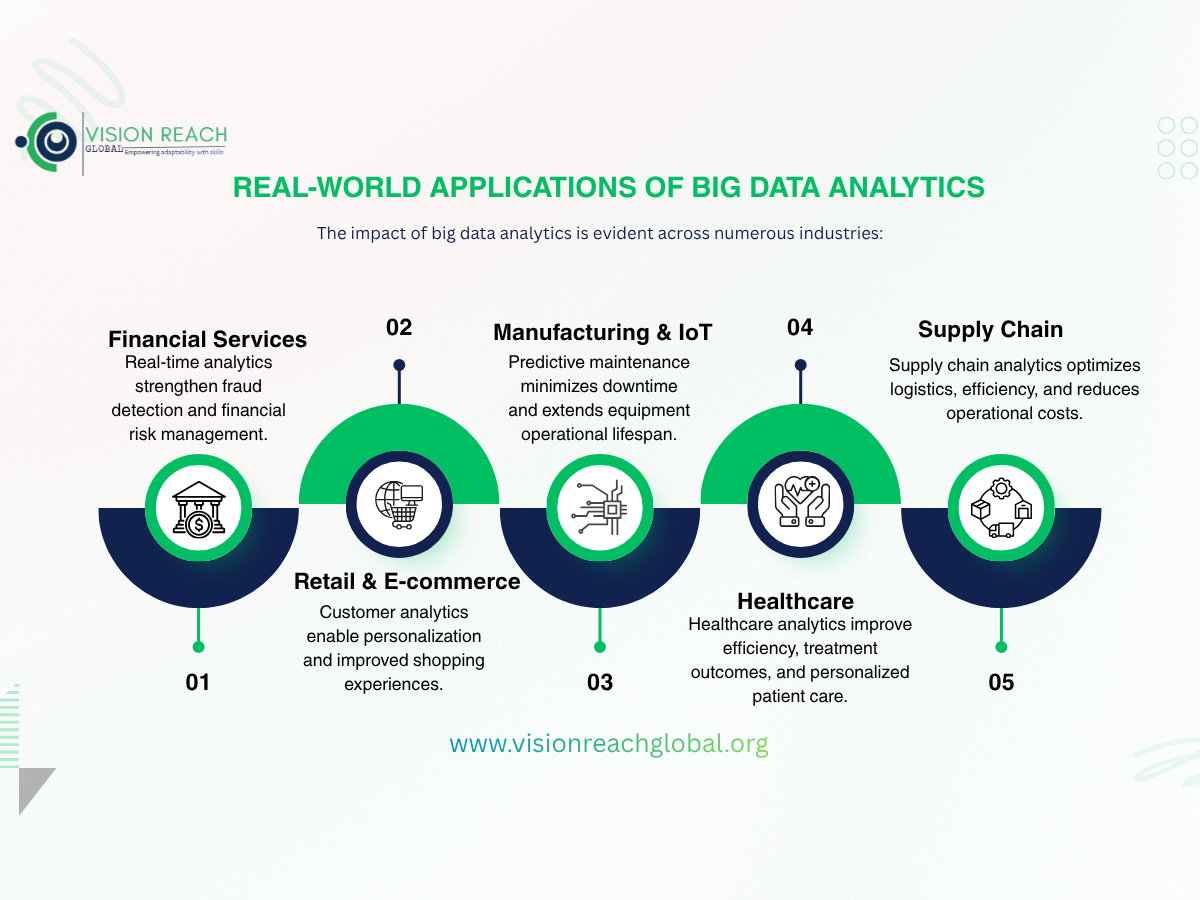
The impact of big data analytics is evident across numerous industries:
- Financial Services: Fraud detection and risk analytics are significantly enhanced, enabling real-time identification of suspicious patterns.
- Retail & E-commerce: Customer behavior analytics and personalization enable tailored marketing campaigns and improved customer experiences.
- Manufacturing & IoT: Predictive maintenance in industrial settings reduces downtime and optimizes equipment lifespan.
- Healthcare: Healthcare analytics drive operational efficiency, improve patient outcomes, and personalize treatment plans.
- Supply Chain: Supply chain intelligence and logistics optimization lead to more efficient operations and reduced costs.
Best Practices for Big Data Analytics Implementation
Successfully implementing big data analytics requires a strategic approach. Enterprises must focus on developing scalable data architectures, ensuring data quality and consistency from the source, and strengthening cybersecurity and access controls. Equally important is building data-driven organizational cultures where insights are valued and acted upon. Hence, continuous monitoring, optimization, and innovation are essential to adapt to evolving data landscapes and business needs.
Conclusion
Data-driven organizations gain a competitive advantage through intelligent analytics and scalable technologies. Therefore, by embracing big data analytics and leveraging powerful platforms like Apache Spark, Hadoop, Python, and Apache NiFi, enterprises can transform raw data into actionable intelligence, driving efficiency, innovation, and growth.
Ready to harness the power of data? Explore our comprehensive Big Data Analytics Training Programs covering Apache Spark, Python, Hadoop, and Apache NiFi to empower your team and elevate your organization’s decision-making capabilities!