

Finding great people is essential for any business aiming to achieve sustainable growth and maintain long-term competitive advantage. As such, a well-defined talent acquisition strategy ensures organizations consistently attract, engage, and retain high-performing individuals across critical roles. Therefore, this guide explores the top strategic talent acquisition frameworks for organizations, helping you align hiring with business outcomes. These frameworks strengthen your talent management strategy while enabling long-term workforce sustainability and measurable performance improvement.
For organizations seeking practical implementation, a Talent Acquisition and Retention Strategies Training Course can significantly enhance execution and results.
Why Strategic Talent Acquisition is Crucial
Strategic talent acquisition goes beyond filling vacancies by aligning recruitment efforts with long-term organizational goals and priorities. This proactive strategic hiring approach enables sustainable growth while reducing inefficiencies associated with reactive recruitment practices. Also, it builds a strong talent pipeline development system that ensures readiness for evolving workforce demands.
According to the Society for Human Resource Management, organizations with structured hiring frameworks experience higher retention and improved workforce productivity outcomes. Additionally, insights from LinkedIn Talent Solutions highlight that companies with strong employer branding attract significantly better candidates.
Essential Elements of a Winning Talent Acquisition Framework
A strong talent acquisition framework provides structured guidance across sourcing, recruitment, onboarding, and long-term retention processes. It also improves efficiency by standardizing workflows and ensuring consistency across hiring stages and departments. As a result, this approach enhances candidate experience, which is critical for attracting top talent in competitive markets.
Additionally, it strengthens employer branding, making organizations more appealing to high-quality candidates and improving recruitment outcomes.
The Top 5 Strategic Talent Acquisition Frameworks Explained
Understanding these frameworks is essential for building a results-driven talent acquisition strategy that supports long-term workforce sustainability. Together, they create an integrated system that enables organizations to attract, select, and retain top-performing employees effectively.
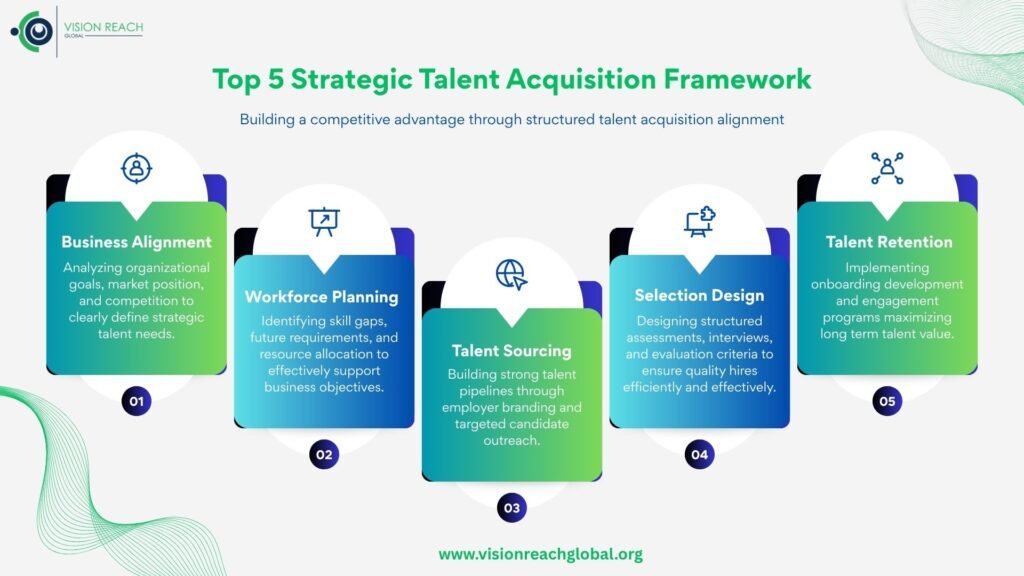
1. Business Alignment: Connecting Hiring to Company Goals
Business Alignment in Talent Acquisition Strategy
This approach requires a clear understanding of growth plans, operational needs, and required workforce capabilities. Recruitment strategies must therefore align with measurable business outcomes to ensure hiring contributes directly to organizational success.
Aligning Roles with Strategic Objectives
Aligning roles with objectives ensures that every hire contributes to performance, innovation, and long-term business growth. Hiring managers must define required competencies that directly influence productivity and organizational success. For example, global expansion strategies require talent with international expertise and cross-cultural communication skills.
Measuring Hiring Impact
Tracking hiring outcomes ensures recruitment strategies deliver measurable value and contribute to overall business performance. In a nutshell, data-driven insights improve decision-making and refine future strategic hiring initiatives for better results.
2. Workforce Planning: Anticipating Future Talent Needs
Strategic Workforce Planning for Hiring Success
Workforce planning anticipates future talent needs based on business growth, industry trends, and evolving market conditions. This proactive approach helps organizations avoid skill gaps and maintain operational efficiency. It also supports long-term human resource strategy by aligning workforce capabilities with future business requirements.
Insights from the World Economic Forum emphasize the importance of future-ready workforce planning in adapting to rapid technological changes.
Analyzing Skill Gaps and Future Demand
Organizations must assess future skill requirements based on technological advancements and market shifts. This enables proactive talent pipeline development and reduces reliance on reactive hiring strategies.
Succession Planning and Internal Mobility
Succession planning identifies future leaders while promoting internal mobility and career development opportunities. As a result, this improves employee retention strategies and strengthens leadership pipelines across the organization.
3. Talent Sourcing: Finding the Right Candidates
Effective Talent Sourcing Strategies for Acquisition
Talent sourcing strategies focus on identifying and engaging candidates through multiple channels to build a diverse talent pool. This includes targeting passive candidates who are not actively searching but possess valuable skills.
Leveraging Diverse Sourcing Channels
Organizations should use job boards, social media, and professional networks to expand sourcing reach and attract diverse candidates. Employee referrals and employer branding, on the other hand, also enhance recruitment effectiveness and candidate engagement.
Engaging Passive Candidates
Engaging passive candidates requires personalized communication, strong employer branding, and long-term relationship-building strategies. This ensures access to high-quality talent that may not be available through traditional recruitment channels.
4. Selection Design: Choosing the Best Fit
Designing Effective Recruitment and Selection Processes
Selection process design focuses on creating structured, fair, and data-driven hiring methods that ensure the best candidate fit. This includes evaluating skills, experience, and cultural alignment consistently across all applicants.
Structured Interviews and Assessments
Structured interviews and assessments improve hiring accuracy by standardizing evaluation criteria across candidates. These methods support objective decision-making and reduce bias in recruitment processes.
Enhancing Candidate Experience
Improving candidate experience in the recruitment process increases offer acceptance rates and strengthens employer reputation in competitive markets. Clear communication and timely feedback are essential for maintaining engagement throughout the hiring journey.
5. Talent Retention: Keeping Your Best People
Strategic Talent Retention in Acquisition Frameworks
Employee retention strategies focus on maintaining valuable employees by fostering engagement and long-term commitment within the organization. High retention reduces recruitment costs and preserves institutional knowledge.
According to Gallup, organizations with strong engagement strategies experience significantly lower turnover rates and higher productivity levels.
Creating a Positive Work Environment
A positive work environment includes recognition, growth opportunities, and work-life balance to enhance employee satisfaction. Competitive compensation and inclusive cultures further strengthen retention and organizational loyalty.
Investing in Employee Development
Continuous training and career development programs improve workforce capabilities and reduce employee turnover rates. Organizations that invest in development build stronger, more resilient teams over time.
Integrating Frameworks and the Role of Training
These strategic talent acquisition frameworks are interconnected and most effective when implemented as part of a unified system. Business alignment informs workforce planning, which guides sourcing, selection, and retention strategies across the organization.
To operationalize this effectively, organizations should invest in a Talent Acquisition and Retention Strategies Training Course, ensuring teams apply best practices consistently.
Building a Holistic Talent Acquisition Strategy
A holistic talent acquisition strategy integrates all recruitment and retention processes into a seamless and efficient system. This approach ensures organizations remain agile and prepared for evolving workforce demands in competitive environments.
Conclusion: Mastering Strategic Talent Acquisition Frameworks
To sum up, implementing these top strategic talent acquisition frameworks provides a structured roadmap for building sustainable and high-performing workforce systems. That is, by focusing on workforce planning, talent sourcing strategies, selection design, and employee retention strategies, organizations can achieve long-term success.
Mastering these frameworks ensures businesses attract, develop, and retain top talent while maintaining alignment with strategic goals and market demands.
Additional Resources
Dave-Vrijsen, & Dave-Vrijsen. (2025, November 11). Top 10 talent acquisition Strategies| SageFlow. Sageflow – Activating Purpose. https://sageflow.com.au/blog/talent-acquisition-strategies/
BioTech Whisperer. (2025, July 28). Building talent pipelines in organizations (7 minutes) [Video]. YouTube. https://www.youtube.com/watch?v=KQ7WDB7ED2s
What is Strategic Hiring? Meaning & Example. (n.d.). skima.ai. https://skima.ai/glossary/strategic-hiring
Employer Branding: Strategy, examples & best practices | Universum. (n.d.). https://universumglobal.com/employer-branding/
14 Effective employee retention strategies. (2025, August 22). Robert Half. https://www.roberthalf.com/us/en/insights/management-tips/effective-employee-retention-strategies
Leong, K. (2024, July 23). Candidate Experience Guide for Recruitment. Harver. https://harver.com/blog/candidate-experience-guide/
Gallup, Inc. (2021). State of the Global Workplace Report. In Gallup.com. https://www.gallup.com/workplace/349484/state-of-the-global-workplace.aspx